Evaluating the Quality and Composition of Date Palm and Banana Fruit Vinegar: Physicochemical and Nutritional Aspects
DOI:
https://doi.org/10.54117/ijpmpr.v2i1.55Keywords:
Physicochemical, Vinegar, Saccharomyces, Acetobacter, Malus, PhoenixAbstract
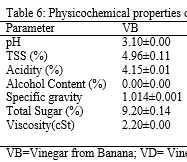
The physicochemical and nutritional composition of vinegar is critically dependent on the choice of fermentation substrate. While vinegar is a globally important condiment, the quality attributes of variants produced from underutilized tropical fruits remain inadequately characterized. Specifically, vinegars derived from Phoenix dactylifera (date palm) and Musa paradiscum (banana), Fruits prized for their high sugar content, dietary fiber, and antioxidant phytochemicals lack a comprehensive scientific evaluation. This study aimed to analyze and compare the quality profiles of vinegar produced from date palm and banana fruit extracts. Yeast (Saccharomyces cerevisiae strain SR 128) and acetic acid bacteria (Acetobacter aceti strain WI) were isolated and used to ferment the respective fruit musts via submerged fermentation. Key physicochemical and proximate nutritional parameters were determined using standard gravimetric and instrumental techniques. Data were analyzed using Analysis of Variance (ANOVA) and Tukey’s post-hoc test at a 95% confidence level. The results showed only slight, statistically non-significant (p > 0.05) variations between the two vinegars. The determined compositional ranges were as follows: moisture (98.70–99.55%), ash (0.27–1.11%), protein (0.10–0.12%), and fat (0.06–0.08%). All measured parameters for both vinegar samples conformed to established food quality standards. Therefore, the prepared vinegar samples from MP and PD had physicochemical and nutritive parameters that conformed to the stipulated standard and the sample prepared from PD was slightly better. Therefore, the prepared vinegar samples from MP and PD had physicochemical and nutritive parameters that conformed with the stipulated standard and the sample prepared from PD was slightly better.
Downloads
Published
How to Cite
Issue
Section
License
Copyright (c) 2026 O. Abba, I. H. Iheukwumere, C. M. Iheukwumere, V. E. Ike, J. N. Ezendianefo, D. J. Okongwu

This work is licensed under a Creative Commons Attribution 4.0 International License.