The Effects of Plants Essential Oils on Biodiesel Fuel Properties during Storage
DOI:
https://doi.org/10.54117/ijet.v1i2.15Keywords:
Agricultural residues, antioxidants, biodiesel quality, climate change, fuel oxidation inhibitionAbstract
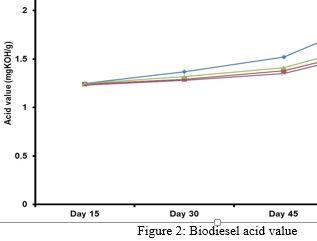
Dilapidation of biodiesel engineering properties is one of its major challenges during storage. The main goal of this research is to evaluate the feasibility of inhibiting the rapid deterioration of palm oil biodiesel (POME) fuel properties during extended storage by blending (incorporating) it with essential oils. POME, produced in accordance with American Society for Testing and Materials (ASTM) guidelines, was fortified with 1% wheat germ oil (Blend 1), 1% avocado seed oil (Blend 2), and a combination of both wheat germ oil (1%) and avocado seed oil (1%) (Blend 3). The fuel properties of these blended biodiesels—acid value and kinematic viscosity—were determined using ASTM procedures. Results obtained from this study revealed that the acid values of the control unit and Blends 1 to 3 increased by 35.90%, 23.93%, 26.04%, and 23.13%, respectively, over the course of 60 days of storage. Furthermore, the kinematic viscosity of the control group and Blends 1 to 3 increased from 4.45 to 4.71, 4.45 to 4.59, 4.45 to 4.62, and 4.45 to 4.56 cSt, respectively, as storage progressed to the 60th day. Remarkably, it was also noted that the hybridization of wheat germ oil and avocado seed oil exhibited the most effective fuel property stabilization results. Individually, the wheat germ oil-treated biodiesel yielded better results compared to the avocado seed oil blend. These findings provide valuable insights into inhibiting the oxidation of palm oil biodiesel. This knowledge has the potential to foster environmental sustainability by reducing dependence on synthetic additives.