Environmental Sanitation and Risk Factors of Indiscriminate Refuse Disposal among Undergraduate Students of Adekunle Ajasin University, Akungba Akoko, Ondo State
DOI:
https://doi.org/10.54117/k95bsa85Keywords:
Environmental sanitation, indiscriminate refuse disposal, undergraduate students, peer influence, waste disposal infrastructureAbstract
Sanitation in the environment is one of the greatest concerns on the overall health of the population in the university setting as a result of population density and generation of solid waste. In 2020, 2.24 billion tonnes of municipal solid waste was produced and projections suggest that it could reach up to 3.4 billion tonnes annually as of 2050 and that only approximately 19-20% of this waste is formally recycled. Unselective dumping of refuse by the undergraduate students is one of the reasons that lead to environmental degradation and increases the chances of developing sanitation related illnesses within the campus. The objective of this study was to determine the level of environmental sanitation and investigate the risk factors that affect careless disposal of refuse among undergraduate students.
The study used a cross-sectional descriptive research design. Undergraduate students of five faculties of Adekunle Ajasin University were used as the target population, and the sample size of the respondents was 210 people, who were obtained through non-probability sampling methods. A structured interviewer-administered questionnaire on cognitive knowledge about environmental sanitation, personal waste disposal behaviour, peer-related social norms and waste disposal infrastructure were used to collect data. The analysis of data was performed in terms of descriptive and inferential statistics, and chi-square tests were carried out at the level of significance of 0.05.
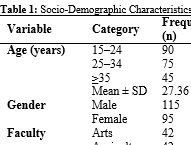
The mean age of respondents was 27.36 ± 7.74 years A majority of respondents demonstrated adequate cognitive understanding of environmental sanitation and refuse-related health risks, and chi-square analysis showed a significant association between knowledge and indiscriminate refuse disposal (χ² = 24.784, df = 12, p < 0.05). Personal waste disposal behaviours were also significant predictors, with a strong association observed between habitual disposal practices and indiscriminate dumping (χ² = 48.156, df = 12, p < 0.05). Peer-related social norms significantly influenced refuse disposal behaviour, as evidenced by a chi-square value of 48.156 at 12 degrees of freedom (p < 0.05). Structural inadequacy of waste disposal infrastructure was likewise significant, with limited availability and irregular waste collection strongly associated with indiscriminate disposal practices (χ² = 37.427, df = 12, p < 0.05).
The findings confirm that indiscriminate refuse disposal among undergraduate students is significantly influenced by cognitive, behavioural, social, and infrastructural factors. It is recommended that university authorities strengthen environmental sanitation education, implement behaviour-focused interventions targeting routine disposal practices, promote positive peer-led sanitation norms, and improve waste management infrastructure through adequate bin provision and regular waste collection.
Downloads
Published
Issue
Section
License
Copyright (c) 2026 Olamide Toyin Oluwajobi, Stephen Ileoye Aina, James Success Odubia, Kolawole Quadril Akinbade, Arajulu Gbenga Abraham, Abiola Olalekan Aminu

This work is licensed under a Creative Commons Attribution 4.0 International License.