Frozen Fish Pathogens: Antimicrobial Resistance and Public Health Implications
DOI:
https://doi.org/10.54117/iijbs.v4i4.77Keywords:
Strain, Antibiotic, Microbiological, Species, SusceptibilityAbstract
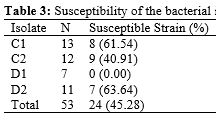
The growing concern of antibiotic-resistant bacteria in the food chain poses a significant threat to public health, particularly with frozen chicken being a potential source of contamination. This study investigates the molecular characterization of bacterial isolates from frozen chicken and their antibiotic resistance profiles. Fifty frozen chicken samples were analyzed using standard microbiological techniques, revealing four bacterial species: Escherichia coli O157:H7 strain NE 1127 (ECNI), Campylobacter jejuni strain RM 1221 (CJRI), Listeria monocytogenes serotype 4b strain 02-6680 (LM02), and Staphylococcus aureus strain WHC09 (SAWO). The antibiotic susceptibility testing showed that 42.76% of the isolates were resistant to conventional antibiotics, while 57.24% were susceptible. Notably, 33.33% of the resistant strains exhibited single antibiotic resistance, and 66.67% displayed multiple antibiotic resistance (MAR). Statistical analysis confirmed the significance of these findings, with a p-value of ≤ 0.05 using the student "t" test and one-way analysis of variance (ANOVA). The study's results highlight the risk of food-borne disease outbreaks associated with consuming frozen chicken contaminated with antibiotic-resistant bacteria. The high prevalence of MAR among bacterial isolates underscores the need for improved sanitation practices, regular water quality monitoring, and public awareness campaigns. These findings have significant implications for public health and food safety in Awka Metropolis, emphasizing the importance of effective control measures to prevent the spread of antibiotic-resistant bacteria in the food chain. Implementing these measures can help mitigate the risk of antibiotic-resistant infections and protect public health.
Downloads
Published
How to Cite
Issue
Section
License
Copyright (c) 2025 V. E. Ike, I. H. Iheukwumere, C. M. Iheukwumere, C. N. Dim, J. N. Ezendianefo, P. A. Egbe, I. P. Oragwu, C. C. Orji, O. C. Ogbonnaya, U. F. Onwuasoanya, F. O. Okereke, S. C. Ochibulu

This work is licensed under a Creative Commons Attribution 4.0 International License.