Proximate and Phytochemical Composition of Ethanolic Extracts from Chromolaena odorata and Zingiber officinale
DOI:
https://doi.org/10.54117/iijbs.v4i4.80Keywords:
Chromolaena odorata, Zingiber officinale, proximate composition, phytochemicals, ulcer management, medicinal plantsAbstract
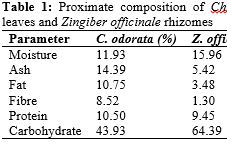
This study evaluated the proximate and phytochemical composition of Chromolaena odorata (Siam weed) leaves and Zingiber officinale (ginger) rhizomes, plants traditionally used in gastrointestinal and ulcer management. Proximate analysis revealed marked nutritional differences: ginger contained higher carbohydrate (64.39%) and moisture (15.96%) levels, while C. odorata was richer in ash (14.39%), fat (10.75%), fiber (8.52%), and protein (10.50%). Phytochemical screening identified a wide range of bioactive compounds, including flavonoids, alkaloids, saponins, cardiac glycosides, tannins, phenols, phytates, oxalates, anthocyanins, steroids and cyanogenic glycosides. Quantitative analysis showed that C. odorata contained higher alkaloids (16.82%) and saponins (19.27%), whereas ginger exhibited higher steroids (12.69%), phenols (5.04%), and flavonoids (6.51%). Tannin and anthocyanin levels were also greater in ginger (4.29% and 4.28%, respectively) compared to C. odorata (1.06% and 2.79%). Both plants contained minimal concentrations of anti-nutritional factors, including phytates (0.70–1.05%), oxalates (0.27–1.06%), and cyanogenic glycosides (0.32–3.19%), indicating safety for therapeutic use. These findings highlight the complementary nutritional and phytochemical profiles of the two species: C. odorata offers higher mineral, protein, and saponin content, supporting its traditional wound-healing and anti-inflammatory roles, while ginger is enriched in carbohydrates, flavonoids, phenols, and steroids, underpinning its antioxidant and gastroprotective activities. Collectively, the results suggest that C. odorata and ginger provide a robust nutritional and bioactive foundation for ethnomedicine, particularly in gastrointestinal health. Further pharmacological and clinical studies are recommended to validate their synergistic therapeutic potential.
Downloads
Published
How to Cite
Issue
Section
License
Copyright (c) 2025 Ihuoma Cyril Akwas, Andrew C. Nwaka, Chukwudi Jude Chikwendu, Chinazor Henrietta Ali, Chukwuebuka Egbuna, Stephen Nnaemeka Ezekwueche

This work is licensed under a Creative Commons Attribution 4.0 International License.