Modulatory Effects of Natural Honey on Lipid Homeostasis and Hepatic Biomarkers in Albino Rats: Evidence of Hepatoprotective Potential
DOI:
10.54117/ijbcm.v3i2.89Published:
2026-05-21Issue:
Vol. 3 No. 2 (2026): Apr-JunKeywords:
Honey, hepatoprotection, lipid profile, oxidative stress, albino rats, liver enzymes, cardiometabolic healthArticles
Downloads
How to Cite
Abstract
Background: Natural honey has been the focus of growing attention due to its potential therapeutic effects, especially concerning oxidative stress, liver functioning, and metabolism. The modulatory effects of natural honey on lipid homeostasis and hepatic biomarkers in the albino rats were evaluated in this study.
Methods: A random assignment of twenty male Wistar albino rats was divided into four groups (n = 5): control (distilled water), low dose honey (1 mL/kg), medium dose honey (2 mL/kg) and high dose honey (4 mL/kg). Honey was given orally every day (21 days). Blood samples were taken at the end of the treatment period to analyze the lipid profile (total cholesterol, triglycerides, HDL-C, LDL-C, VLDL-C) and hepatic biomarkers (AST, ALT, ALP, total, conjugated and unconjugated bilirubin). The one-way ANOVA with Tukey post hoc test (p < 0.05) was used to analyze the data.
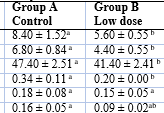
Results: Honey administration was seen to significantly decrease the level of AST, ALT, ALP in the treated groups when compared to the control group (p<0.05). There was also a significant decrease in total bilirubin and unconjugated bilirubin levels but no significant change in conjugated bilirubin. However, no significant difference was seen among the lipid profile parameters (p > 0.05) except for slight differences in triglycerides and VLDL-C and a strong positive correlation was seen between the hepatic markers (AST, ALT, ALP). There was also a significant positive correlation of triglycerides to VLDL-C, and relatively poor correlations of the lipid profile parameters to the hepatic biomarkers..
Conclusion: Under normal physiological conditions, natural honey did not exhibit strong lipid-modulatory activity but displayed strong hepatoprotective activity. These results indicate that the cardiometabolic effects of honey could be mainly mediated by the hepatic stabilization and antioxidant effects of honey instead of direct lipid lowering.
Author Biographies
Chibuike Anthony Innocent, Department of Medical Biochemistry, Faculty of Basic Medical Sciences, College of Medicine, Imo State University, Owerri, Imo State, Nigeria
Chigaemezu Remmy-Martin Akubuo, Department of Microbiology, Faculty of Biological Science, Imo State University Owerri, Imo State, Nigeria
Lovelyn Chiamaka Nnanyereugo, Department of Biology and Genetics, Institute of Digital Biodesign and Artificial Intelligence in Medicine, I.M. Sechenov First Moscow State Medical University (Sechenov University), Moscow, Russia.
Uchechukwu Richard Njoku, Department of Biochemistry, Faculty of Biological Sciences, Imo State University, Nigeria
Bright Odinaka Okorocha, Department of Medicine and Surgery, NnamdiAzikiwe University, Awka, Anambra State, Nigeria
Favour Ogechi Ahanonu, Department of Human Physiology, Faculty of Basic Medical Science, College of Medicine, Imo State University, Owerri Imo State, Nigeria
License
Copyright (c) 2026 Chibuike Anthony Innocent, Chigaemezu Remmy-Martin Akubuo, Lovelyn Chiamaka Nnanyereugo, Uchechukwu Richard Njoku, Bright Odinaka Okorocha, Favour Ogechi Ahanonu

This work is licensed under a Creative Commons Attribution 4.0 International License.