Assessment of Knowledge and Practice of Waste Management among Healthcare Workers in Nasarawa State, Nigeria
DOI:
https://doi.org/10.54117/nrxw8q59Keywords:
Healthcare waste, Healthcare workers, Knowledge, Nasarawa, PracticeAbstract
Background: The risk of exposure to harmful agents by healthcare workers, patients, and the surrounding communities, as well as environmental contamination due to the improper disposal of medical waste, remains a global challenge.
Aim: This study was conducted to assess the knowledge and practices of healthcare workers regarding medical waste management in Nasarawa State, Nigeria, focusing on issues such as categories, problems related to medical waste, and procedures for handling and disposal.
Study Design and Duration: The study was a descriptive cross-sectional questionnaire-based study conducted on healthcare workers between September 2024 to October2024.
Methodology: A questionnaire-based study involving 422 healthcare workers was designed having both open-ended and closed-ended items that were divided into three parts as follows: part A: sociodemographic characteristics of the respondents; part B: knowledge of respondents about medical waste management; part C practice of respondents regarding medical waste management. Data obtained from this study were analysed using the chi-square test and the Fisher’s Exact test.
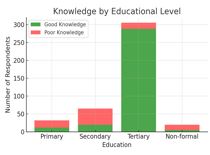
Results: The study revealed a good level of knowledge of waste management (95.0%) among the 422 healthcare workers studied. Chi-square analysis revealed that age group (χ² = 86.95, P < 0.05), staff category (χ² = 81.57, P < 0.05), level of education (χ² = 197.68, P< 0.05), years in practice (χ² = 90.87, P < 0.05) and prior training on healthcare waste management (χ² = 195.54, P < 0.05) were all significantly associated with knowledge levels. In contrast, gender was not statistically associated with knowledge (χ² = 0.78, P > 0.05).
Conclusion: Although this study revealed a good knowledge of waste management among participants, there are discrepancies in the training, practice of waste management and the absence of waste management and disposal systems in some facilities. There is a need for adequate awareness and training for healthcare workers, especially health attendants and waste handlers. Furthermore, sufficient funding and strict regulations are needed to mitigate the health hazards related to improper healthcare waste management.
Downloads
Published
Issue
Section
License
Copyright (c) 2025 Ismaila Ibrahim, Mitsan Olley, Daniel Ugbomoiko, David Ishaleku, Rahila Ukwo Usman, Nelson Gideon Maryoms, Mercy Ehi Owoyele, Saidat Folake Bello, Victor Ochapa Aboh

This work is licensed under a Creative Commons Attribution 4.0 International License.