Availability and Utilization of Psychological Support Services among Cancer Patients in Rivers State University Teaching Hospital (RSUTH)
DOI:
https://doi.org/10.54117/65yrdn54Keywords:
Psychological support, cancer patients, psycho-oncology, counselling, distress management, psychosocial services, Rivers State University Teaching Hospital, Port HarcourtAbstract
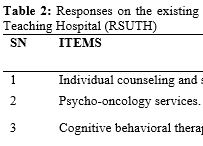
Cancer remains a major global health concern and is associated with profound psychological distress that can negatively affect treatment adherence, recovery, and quality of life. Integrating psychological support into oncology care has therefore become a critical component of comprehensive cancer management. This study assessed the availability and utilization of psychological support services among cancer patients at Rivers State University Teaching Hospital (RSUTH), Port Harcourt, Nigeria. A descriptive cross-sectional design was employed, involving a total of 133 cancer patients who participated through a structured self-administered questionnaire. Data were analyzed using descriptive statistics, with a criterion mean of 2.5 serving as the benchmark for determining the availability and utilization of services. Findings revealed that several psychological support services were available to cancer patients at RSUTH. These included individual counselling and support groups (M = 3.24), psycho-oncology services (M = 3.13), cognitive behavioral therapy (M = 2.87), family counselling (M = 3.01), palliative care and hospice support (M = 3.32), and mindfulness and stress reduction programs (M = 2.95). Since all mean scores exceeded the criterion benchmark, the results indicate that these services are generally available and moderately utilized by patients. Despite this positive indication, the findings suggest gaps in awareness, accessibility, and routine integration of psychosocial interventions into oncology care. Many patients may still not fully benefit from existing services due to limited information, cultural stigma, or insufficient referral systems. The study concludes that while RSUTH demonstrates encouraging progress toward holistic cancer care, further efforts are required to institutionalize psychological assessment and support as standard practice, thereby enhancing emotional well-being, treatment adherence, and overall quality of life among cancer patients.
Downloads
Published
Issue
Section
License
Copyright (c) 2025 Aleruchi Lenchi Oji, Udo Orukwowu

This work is licensed under a Creative Commons Attribution 4.0 International License.