Seroprevalence of Syphilis Among Pregnant Women in Onitsha, Nigeria: A Cross-Sectional Study
DOI:
https://doi.org/10.54117/2j3nnq87Keywords:
Syphilis, Pregnancy, Antenatal, NigeriaAbstract
Background: Syphilis remains a significant global public health concern, particularly in pregnancy where it contributes to adverse maternal and neonatal outcomes. Despite ongoing control efforts, the burden of maternal syphilis persists in many parts of sub-Saharan Africa.
Objective: This study aimed to determine the seroprevalence of syphilis and its association with socio-demographic characteristics, awareness, and medical history among pregnant women in Onitsha, Nigeria.
Methods: A cross-sectional study was conducted among 125 pregnant women attending antenatal clinic at St. Charles Borromeo Specialist Hospital, Onitsha. Blood samples were collected and analyzed for antibodies against Treponema pallidum using enzyme-linked immunosorbent assay (ELISA). Socio-demographic data, awareness levels, and medical history were obtained using structured questionnaires. Data were analyzed using descriptive statistics and chi-square tests.
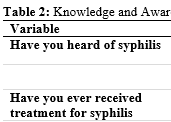
Results: The study recorded a zero prevalence of syphilis (0.0%), with no positive cases detected among all participants. This absence was consistent across all socio-demographic variables including age, marital status, education, occupation, and trimester (p = 1.0). Despite this, 71.2% of participants were aware of syphilis, while 20.8% reported a history of sexually transmitted infections. Additionally, some participants reported potential risk exposures such as prior surgery (23.2%), blood transfusion (5.6%), and needle sharing (3.2%).
Conclusion: The absence of syphilis in this study suggests a very low burden of infection in the study population despite the presence of awareness gaps and risk factors. Continued antenatal screening and surveillance are essential to sustain this trend and prevent re-emergence.