Toxicity and Safety Evaluation of Glycolipid Biosurfactant Produced by Yeast Strains Isolated from Fruit Pastes
DOI:
10.54117/axm1gf40Published:
2026-02-01Downloads
Abstract
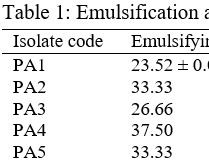
This study was undertaken to evaluate the toxicity and safety of glycolipid biosurfactant produced by yeast strains isolated from fruit pastes. Yeast strains were isolated from ripe pineapple (Ananas comosus) and unripe plantain (Musa paradisiaca) pastes using enrichment technique and screening for their biosurfactant potentials using emulsification and oil displacement tests. The yeast strains were characterized and identified using classical microbiological techniques. The crude biosurfactants produced were characterized biochemically and their toxicity status evaluated using phytotoxicity test. The result revealed that a total of 10 strains of yeast were isolated from the fruit pastes. The yeast strain PA4 had the highest emulsification activity of 37.50 % while yeast strain PA1 had the lowest emulsification activity of 23.52 %, respectively. Also, PA3 had the highest dispersive index of 24.64 mm, while PL3 had the lowest dispersive index of 8.54 mm, respectively. The yeast strains were classically identified as Trichosporon sp. and Candida sp. They were found to be glycophospholipid in nature as well as non – toxic to Zea mays seeds at low concentrations. The study has helped to synthesize a low cost and ecofriendly glycophospholipid biosurfactant which consolidates the ecological acceptability of biosurfactant.
Keywords:
Bioeconomy, Biosafety, Biotoxicity, Ecological acceptability, Glycolipid biosurfactantLicense
Copyright (c) 2026 B. O. Uba, P. I. Udaba, N. A. Dibua, C. C. Ubajekwe, V. C. Igiri, D. J. Okongwu, E. C. Anaebonam

This work is licensed under a Creative Commons Attribution 4.0 International License.