Inhibitory Effects of Termicin on Multidrug-Resistant Bacillus cereus: A Peptide Antibiotic Approach
DOI:
https://doi.org/10.54117/ijddrr.v4i1.52Keywords:
Termicin, antimicrobial peptide, Bacillus cereus, multidrug resistanceAbstract
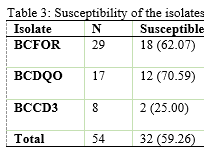
The increasing prevalence of multidrug-resistant (MDR) Bacillus cereus in food systems poses a serious threat to public health and food safety, driven by its ability to cause foodborne illness, spoilage, and resistance to multiple classes of conventional antibiotics. This study evaluated the inhibitory effects of termicin, a termite-derived antimicrobial peptide, against MDR B. cereus strains isolated from commercial powdered soybean samples obtained from retail outlets in Awka Metropolis. Out of the samples analyzed, 33% were positive for Bacillus species. Phenotypic and biochemical characterization, followed by 16S rRNA gene sequencing, confirmed the isolates as B. cereus strains FORC60 (BCFOR), DQ01 (BCDQO), and CD3 (BCCD3), each showing 100% sequence identity with reference strains. Antibiotic susceptibility testing revealed substantial multidrug resistance, with an overall resistance rate of 40.74%; notably, BCCD3 exhibited the highest resistance level (75%), spanning multiple antibiotic classes. In contrast, termicin demonstrated strong, concentration-dependent inhibitory activity against all isolates, including the highly resistant BCCD3 strain. Increasing termicin concentrations (0.1–1.0%) resulted in a marked reduction in bacterial growth, with near-complete inhibition observed at the highest concentration. These findings indicate that termicin retains potent antimicrobial activity against MDR B. cereus despite resistance to conventional antibiotics, highlighting its promise as a peptide antibiotic candidate and a natural biocontrol agent for managing drug-resistant spore-forming pathogens in food and public health applications.
Downloads
Published
How to Cite
Issue
Section
License
Copyright (c) 2026 C. M. Iheukwumere, I. H. Iheukwumere, B. C. Unaeze, V. E. Ike

This work is licensed under a Creative Commons Attribution 4.0 International License.