Evaluation of the Production of Biosurfactant by Yeast Strains Isolated from Fruit Pastes and their Biodegradative Potential on Waste Engine Oil
DOI:
https://doi.org/10.54117/ejmptp50Keywords:
Bioaugmentation, Biosurfactant, Half - life, Kinetics, YeastAbstract
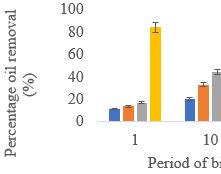
Oil pollution and remediation technology have become a global phenomenon of increasing importance. Most of the hydrocarbons are insoluble in water and their degradation using microorganisms has an important role in combating environmental pollution. This study was undertaken to evaluate the production of biosurfactant by a yeast strain isolated from fruit pastes and its biodegradative potential on waste engine oil. Yeast strains were isolated from ripe pineapple (Ananas comosus) and unripe plantain (Musa paradisiaca) pastes and screening for their biosurfactant potentials using emulsification test. Gravimetric method using N – hexane as extractive solvent was employed in determining the biodegradative potentials of the yeast consortium and their biosurfactants on waste engine oil contaminated soil and seawater, respectively. The result revealed that a total of 10 strains of yeast were isolated from the fruit pastes. The yeast strain PA4 had the highest emulsification activity of 37.50 % while yeast strain PA1 had the lowest emulsification activity of 23.52 %, respectively. The lowest percentage oil removal values of 22.0, 43.8, 57.2 and 79.4 % were obtained at day 1 while the highest percentage oil removal values of 97.4, 94.0, 96.0 and 96.2 % were obtained at day 60 in all the polluted soil treatments, respectively with non - significant differences (p > 0.05) detected among the means of different treatment conditions and remediation period in comparison to the control setup. Also, the lowest percentage oil removal values of 11.2, 20.40, 52.8 and 73.2 % were obtained at day 1 while the highest percentage oil removal values of 84 .0, 85.8, 80.2 and 84.0 % were obtained at day 30 in all the polluted seawater treatments, respectively with significant differences (p < 0.05) detected among the means of different treatment conditions and remediation period in comparison to the control setup. The biodegradation data fit well into pseudo first order kinetic model and value of the kinetic parameter showed that the degree of effectiveness of these bioremediation strategies in the cleanup of soil contaminated with waste engine oil is in the following order: C3 < C2 < C1 < Co while the cleanup of seawater contaminated with waste engine oil is in the following order: Co < C3 < C2 < C1, respectively. Thus, yeast consortium and the biosurfactants produced, besides being obtained from low cost substrates, revealed effectiveness in the clean-up and dispersion of waste engine oils in soil and seawater, allowing the replacement of physical and chemical treatment agents with environmental friendly agents. The study has also helped to bridge the gap of knowledge on isolation of biosurfactant producing yeast strains from non – polluted sources.
Downloads
Published
Issue
Section
License
Copyright (c) 2026 B. O. Uba, P. I. Udaba

This work is licensed under a Creative Commons Attribution 4.0 International License.