Influence of Environmental Pollutant Sediment on Processing Equipment and its Implications for the Nutritive Properties of Detarium microcarpum and Brachystegia eurycoma Seeds
DOI:
https://doi.org/10.54117/7gc4xk18Keywords:
Detarium microcarpum, food, heavy metals, equipmentAbstract
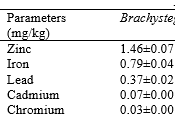
This study examined the impact of environmental pollutants’ sediment on food processing equipment and its effects on Detarium microcarpum and Brachystegia eurycoma seeds processed using Attrition mill, wooden mortar and stone slab. The processed seed samples were examined for trace elements and heavy metals alike, using Agilent FS240AA Atomic Absorption Spectrophotometer. The result of the analysis showed Iodine and Zinc were the most predominant mineral elements and heavy metal observed with values at 74.22±3.43mg/kg and 1.46±0.07mg/kg for D. microcarpum (DM) and B. eurycoma (BE) processed with attrition mill. Chromium and Lead were higher in dust sediment with concentration of 15.76±0.57mg/kg and 9.29±0.12mg/kg from Attrition mill Equipment. The average daily dose (ADD) highest peak shows (Zinc, 0.400mg/kg and, 0.350mg/kg in DM, BE), Ingestion Dose (ID) highest peak (Zinc, 1.829mg/kg in DM, and 2.086mg/kg, in BE). Inhalation Dose (ID) highest peak (Zinc, 0.400mg/kg, BE, and 0.351mg/kg, DM). Hazard Quotient (HQ) (Pb, 28.943mg/kg, in both samples). Hazard index (HI) (58.9364mg/kg, DM and 52.1229mg/kg, BE). Target Hazard Quotient (THQ) (Pb, 0.3965mg/kg, in both samples). Total Target Hazard Quotient (TTHQ) (0.714mg/kg, BE and 0.807mg/kg, DM). Life Cancer Risk (LCR) (Cd, 0.0287mg/kg, BE and 0.0410mg/kg, DM) Investigation showed that attrition mill processing method raised concerns about long-term exposure to hazardous substances. This study highlights the urgent need for safer processing techniques to mitigate heavy metal contamination while preserving the quality of locally processed food.
Downloads
Published
Issue
Section
License
Copyright (c) 2026 R. C. Ohiri, U. B. Eze, F. C. Anacletus, S. O. Godwin, Barile Nwikiri

This work is licensed under a Creative Commons Attribution 4.0 International License.