Comparative Evaluation of the Antibacterial Activity of Culinary Spice Extracts against Selected Bacterial Pathogens
DOI:
https://doi.org/10.54117/iijbs.v6i1.119Keywords:
Antimicrobial activity, Spice extracts, Foodborne pathogens, Minimum inhibitory concentration, Synergistic effectsAbstract
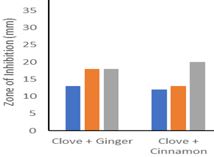
This study evaluated the antimicrobial activity of ethanolic and aqueous extracts of four commonly used spices clove (Syzygium aromaticum), cinnamon (Cinnamomum verum), ginger (Zingiber officinale), and garlic (Allium sativum) against selected bacterial pathogens: Staphylococcus aureus, Escherichia coli, and Salmonella typhi. Antimicrobial efficacy was assessed using the agar well diffusion method, while minimum inhibitory concentration (MIC) and minimum bactericidal concentration (MBC) were determined by the broth dilution technique. The inhibitory effects of the spice extracts were compared with a standard antibiotic (ciprofloxacin), and combination studies were conducted to evaluate possible synergistic interactions. The ethanolic extract of clove exhibited zones of inhibition (ZOI) of 12 mm, 15 mm, and 21 mm against S. typhi, E. coli, and S. aureus, respectively, with corresponding MIC/MBC values ranging from 125–500 mg/ml. Cinnamon extract also demonstrated broad-spectrum activity, producing ZOI of 17 mm, 13 mm, and 16 mm against S. typhi, E. coli, and S. aureus, respectively. In contrast, ginger and garlic extracts showed antimicrobial activity only against S. aureus, with inhibition zones of 21 mm and 15 mm, respectively. Among the aqueous extracts, only clove showed inhibitory activity against S. aureus and E. coli. Overall, ethanolic extracts displayed significantly higher antimicrobial activity than aqueous extracts. Staphylococcus aureus was the most susceptible organism, while E. coli and S. typhi were comparatively less sensitive. Combination studies revealed notable synergistic activity between clove and cinnamon extracts against S. aureus. Although ciprofloxacin produced larger inhibition zones, the spice extracts demonstrated appreciable antimicrobial effects. These findings indicate that selected spices, particularly clove and cinnamon, possess bioactive compounds with potential application as natural antimicrobial agents in the control of foodborne pathogens and microbial infections.
Downloads
Published
How to Cite
Issue
Section
License
Copyright (c) 2026 Nnenna Jennifer Omorordion, Chiamaka Glory Chukwujiezi

This work is licensed under a Creative Commons Attribution 4.0 International License.