Evaluation of Cadmium, Cortisol, and C-Reactive Protein in Male Smokers in Onitsha, Anambra
DOI:
https://doi.org/10.54117/iijbs.v6i1.129Abstract
Background: Tobacco smoking remains a leading cause of morbidity and mortality worldwide, with cadmium exposure, stress, and inflammation being key biological pathways involved in smoking-related diseases. This study evaluated blood levels of cadmium, serum cortisol, and C-reactive protein (CRP) in male smokers in Onitsha, Anambra State, Nigeria.
Methods: A total of 180 male participants aged 18 years and above were recruited, comprising 105 smokers and 75 non-smokers. Data on demographics and smoking history (including number of cigarettes smoked per day) were obtained using structured questionnaires. Venous blood samples were collected and analyzed for blood cadmium, serum cortisol, and CRP using atomic absorption spectrophotometry and enzyme-linked immunosorbent assay (ELISA) methods. Parameters were compared between smokers and non-smokers, as well as among smokers stratified by age and quantity smoked. Correlation and regression analyses were used to explore relationships between cadmium and the other biomarkers.
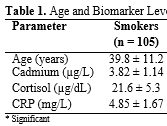
Results: Mean blood cadmium levels were significantly higher in smokers (3.82 ± 1.14 µg/L) compared to non-smokers (1.27 ± 0.64 µg/L; p = 0.001). Similarly, mean cortisol levels were elevated in smokers (21.6 ± 5.3 µg/dL) versus non-smokers (14.3 ± 4.2 µg/dL; p = 0.0001), as was CRP (4.85 ± 1.67 mg/L in smokers vs. 2.01 ± 1.08 mg/L in non-smokers; p = 0.002). Among smokers, older age groups (>45 years) and those smoking more than 10 cigarettes per day showed significantly higher levels of all three parameters (p < 0.05). Cadmium was positively correlated with cortisol (r = 0.61, p = 0.0001) and CRP (r = 0.54, p = 0.0001). In multiple regression analysis, cadmium was a significant predictor of both cortisol (β = 0.58, p = 0.0001) and CRP (β = 0.49, p = 0.0001), after adjusting for age and quantity smoked.
Conclusion: This study demonstrates that male smokers in Onitsha have significantly elevated blood levels of cadmium, serum cortisol, and CRP, with cadmium showing strong associations with stress and inflammatory biomarkers. These findings emphasize the systemic toxicological burden of smoking and the need for targeted public health interventions in this population.
Downloads
Published
How to Cite
Issue
Section
License
Copyright (c) 2026 Chikaodili N. Obi-Ezeani, Ifeoma J. Onuora, Eugenia O. Nnoruka, Amuche L. Onuike, Onyebuchi D. Chikezie, Onyema A. Onyegbule

This work is licensed under a Creative Commons Attribution 4.0 International License.