In Vitro Antioxidant and Phytochemical Analysis of Solanum aethiopicum (Garden Egg Leaf) and Telfairia occidentalis (Fluted Pumpkin Leaf)
DOI:
https://doi.org/10.54117/iijbs.v4i3.56Keywords:
In vitro antioxidant activity, phytochemical analysis, Solanum aethiopicum, Telfairia occidentalis, nitric oxide scavengingAbstract
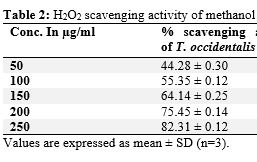
This study evaluated and compared the in vitro antioxidant activity and phytochemical constituents of methanol leaf extracts of Solanum aethiopicum and Telfairia occidentalis. The phytochemical analysis of both Solanum aethiopicum and Telfairia occidentalis revealed the presence of alkaloids, saponins, flavonoids, terpenoids, glycosides, and steroids in both plant extracts, whereas tannins were absent in Solanum aethiopicum but present in Telfairia occidentalis. The results showed that the methanol leaf extracts of T. occidentalis and S. aethiopicum were able to scavenge nitric oxide in a dose-dependent manner, with a concentration of 50 µg/ml giving the least percentage scavenging activity (38.20 ± 0.32 and 36.20 ± 0.12), while a concentration of 250 µg/ml gave the highest percentage scavenging activity (80.39 ± 0.14 and 74.35 ± 0.14), respectively. The results also showed that the methanol leaf extracts of T. occidentalis and S. aethiopicum were able to scavenge hydrogen peroxide (H₂O₂) in a dose-dependent manner, with a concentration of 50 µg/ml giving the least percentage scavenging activity (44.28 ± 0.30 and 40.23 ± 0.14), while a concentration of 250 µg/ml gave the highest percentage scavenging activity (80.39 ± 0.14 and 75.33 ± 0.22), respectively. The results of the nitric oxide scavenging activity and hydrogen peroxide scavenging activity, as measures to assess the in vitro antioxidant potential of the two extracts, revealed that T. occidentalis has higher antioxidant scavenging activity when compared to Solanum aethiopicum. The recorded high antioxidant activity may be due to the presence of phytochemicals in the plants. We conclude that the methanol leaf extracts of T. occidentalis and S. aethiopicum have in vitro antioxidant scavenging activity against nitric oxide and hydrogen peroxide radicals, and the observed antioxidant activity may be due to the presence of phytochemicals in the plant extracts.
Downloads
Published
How to Cite
Issue
Section
License
Copyright (c) 2025 C. C. Ilechukwu, C. O. Ezenwelu, J. C. Ifemeje, C. Okechukwu, J. N. Ilechukwu, I. H. Iheukwumere

This work is licensed under a Creative Commons Attribution 4.0 International License.