Assessment of Blood Indices in Rats Supplemented with Macrotermes-Derived Nutrient-Enhanced Bacteria
DOI:
10.54117/ijbcm.v2i4.39Published:
2025-11-19Issue:
Vol. 2 No. 4 (2025): Oct-DecKeywords:
Macrotermes, Nutrient-enhanced-bacteria, Blood-indices, HaematologicalArticles
Downloads
How to Cite
Abstract
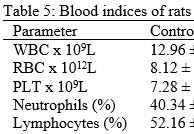
The use of antibiotics in animal production has raised concerns about antimicrobial resistance and residues in food products. There is a need for alternative growth promoters that are safe and effective. This study assessed the impact of Macrotermes-derived nutrient-enhanced bacteria on blood indices in rats, exploring their potential as a novel approach to improving animal health and nutrition, and addressing the limitations of conventional growth promoters. The bacterial symbionts used were Lactiplantibacillus plantarum strain ZG308 (LPZ3), Limosilactobacillus fermentum strain 2760 (LF2), Bifidobacterium dentum strain MB0148 (BDM1), and Bifidobacterium bifidum strain CNCM1-4319 (BBC4), which were isolated and characterized from Macrotermes’ gut using standard microbiological techniques.The study investigated the impact of nutrient-enhanced bacterial symbionts from Macrotermes species on blood indices in rats. The results showed a significant (p<0.05) increase in WBC, RBC, PLT, and lymphocyte counts, and a significant (p<0.05) reduction in monocyte and eosinophil counts, while basophil counts remained constant. The study concluded that supplementation with nutrient-enhanced bacterial symbionts positively modulates blood indices by improving haematological profiles.
Author Biographies
M. A. Idigo, Department of Biological Sciences, Faculty of Natural Sciences, Chukwuemeka Odumegwu Ojukwu University, Uli, Campus, Anambra State, Nigeria.
I. H. Iheukwumere, Department of Microbiology, Faculty of Natural Sciences, Chukwuemeka Odumegwu Ojukwu University, Anambra State, Nigeria.
C. M. Iheukwumere, Department of Applied Microbiology & Brewing, Faculty of Biosciences, Nnamdi Azikiwe University Awka, Nigeria.
B. C. Nnaeze, Department of Medical Microbiology and Public Health, Faculty of Medical Laboratory Sciences, Nnamdi Azikiwe University, Nnewi Campus, Nigeria.
C. J. Akulue, Department of Medical Microbiology and Public Health, Faculty of Medical Laboratory Sciences, Nnamdi Azikiwe University, Nnewi Campus, Nigeria.
N. E. Nwakoby, Department of Microbiology, Faculty of Natural Sciences, Chukwuemeka Odumegwu Ojukwu University, Anambra State, Nigeria.
J. N. Ezendianefor, Department of Microbiology, Tansian Universiy, Umunya, Anambra State, Nigeria.
V. E. Ike, Department of Microbiology, University of Agriculture and Environmental Sciences, Umuagwo, Imo State, Nigeria.
A. O. Nnaedozie, Department of Microbiology, Faculty of Natural Sciences, Chukwuemeka Odumegwu Ojukwu University, Uli, Campus, Anambra State, Nigeria.
S. N. Ezekwueche, Department of Microbiology, University of Agriculture and Environmental Sciences, Umuagwo, Imo State, Nigeria.
I. S. Anagor, Department of Medical Microbiology and Parasitology, Faculty of Basic Clinical Sciences, Nnamdi Azikiwe University, Nnewi Campus, Nigeria.
C. C. Aniekwe, Department of Applied Microbiology and Brewing, Faculty of Biosciences, Nnamdi Azikiwe University, Awka, Nigeria
F. C. Ezeoke, Department of Animal Science, Faculty of Agriculture, Chukwuemeka Odumegwu Ojukwu University, Igbariam Campus, Anambra State, Nigeria.
F. O. Okereke, Department of Biological Sciences (Microbiology), Faculty of Natural and Applied Sciences, Spiritan University, Nneochi, Abia State, Nigeria.
S. C. Ochibulu, Department of Microbiology, Faculty of Natural Sciences, Chukwuemeka Odumegwu Ojukwu University, Uli, Campus, Anambra State, Nigeria.
License
Copyright (c) 2025 M. A. Idigo, I. H. Iheukwumere, C. M. Iheukwumere, B. C. Nnaeze, C. J. Akulue, N. E. Nwakoby, J. N. Ezendianefor, V. E. Ike, A. O. Nnaedozie, S. N. Ezekwueche, I. S. Anagor, C. C. Aniekwe, F. C. Ezeoke, F. O. Okereke, S. C. Ochibulu

This work is licensed under a Creative Commons Attribution 4.0 International License.