
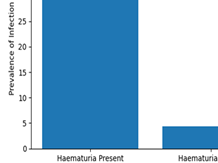
Prevalence of Schistosoma haematobium infection among schoolchildren dewormed within the past year in Agulu, Anambra State.
Schistosoma Infection in Dewormed School-children
DOI:
10.54117/ijamb.v6i2.167Published:
2026-05-23Issue:
Vol. 6 No. 2 (2026): Apr-JunKeywords:
Haematuria, Prevalence, Schistosoma haematobium, school-childrenArticles
Downloads
How to Cite
Downloads
Abstract
Background: Urinary schistosomiasis caused by Schistosoma haematobium remains a significant public health concern in sub-Saharan Africa, particularly among school-aged children who are highly exposed to infested water bodies. Although mass drug administration (MDA) with praziquantel is widely implemented, reinfection continues to limit its long-term effectiveness in endemic communities.
Objective: This study determined the prevalence of S. haematobium infection among schoolchildren dewormed within the past year in Agulu, Anambra State, Nigeria, and examined associated demographic and clinical factors.
Methods: A cross-sectional study was conducted among 187 schoolchildren. Midday urine samples were collected and examined microscopically for the presence of S. haematobium eggs. Data on age, sex, water contact, urine appearance, and haematuria were obtained using structured questionnaires and standard urinalysis procedures. Data were analysed using descriptive statistics.
Results: The overall prevalence of infection was 9.6%. Infection was highest among children aged 11–13 years and more frequent in females than males. Haematuria was observed in 14.7% of participants and was strongly associated with infection, with a markedly higher proportion of infected cases among those presenting with haematuria than among those without. In contrast, urine turbidity was not consistently associated with infection. A substantial proportion of participants reported water contact, indicating continued exposure to transmission sources despite prior treatment.
Conclusion: The persistence of S. haematobium infection one year after MDA suggests ongoing transmission and rapid reinfection in the study area. These findings highlight the need for integrated control strategies, including improved water supply, sanitation, and hygiene, as well as sustained health education, to complement chemotherapy and achieve long-term reductions.
Author Biographies
Chinelo Kene Ezejiegu, Department of Pharmaceutical Microbiology and Biotechnology, Faculty of Pharmaceutical Sciences, Nnamdi Azikiwe University, Awka, Anambra State.
Tomike-Okwuije Nwachetam, Department of Pharmaceutical Microbiology and Biotechnology, Faculty of Pharmaceutical Sciences, Nnamdi Azikiwe University, Awka, Anambra State.
Ugochukwu Moses Okezie, Department of Pharmaceutical Microbiology and Biotechnology, Faculty of Pharmaceutical Sciences, Nnamdi Azikiwe University, Awka, Anambra State.
License
Copyright (c) 2026 Chinelo Kene Ezejiegu, Tomike-Okwuije Nwachetam, Ugochukwu Moses Okezie

This work is licensed under a Creative Commons Attribution 4.0 International License.
CC BY 4.0