Effect of Formulated Breadnut (Artocarpus camansi)-Based Infant Foods on Lipid Profile and Hematological Indices of Wistar Rats
DOI:
https://doi.org/10.54117/k180by62Keywords:
Formulation, Complementary food, Juvenile obesity, anaemia, locally available foodAbstract
Background: Cases of juvenile obesity, iron deficiency among infants, and the high cost of commercial complementary foods are public health problems. Commercial complementary foods are expensive and not affordable to all, even though the nutrient claims on the labels may not be reliable. Infant malnutrition, due to poor quality of complementary foods, is the main cause of mortality among infants and children in many sub-Saharan African countries, including Nigeria. Complementary foods for weaning infants are usually produced by nursing mothers/caregivers using only cereals most time, with little or no nutrient improvement by protein-rich staple foods, while there are locally grown and available protein-rich seeds that can also control and boost Lipid profile and hematology, respectively.
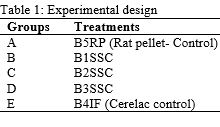
Methods: The study formulated and evaluated the consumption of complementary foods made from composites of breadnut, sorghum, soybeans and crayfish, compared it with commercial food as regards the health implications on some biochemical parameters of Albino rats. Breadnut and sorghum were processed using standard methods and combined in the ratio of 50:50 (B1SSC), 70:30 (B2SSC), and 80:20 (B3SSC), while soybeans and crayfish were 20:10 at a constant rate in the formulated foods. 100 % cerelae (B4IF) and pelletized (B5RP) rat feed were used as controls. Fifty (50) weaning albino rats of the Wistar strain, weighing between 42 and 62 g were used for the study. The animals were assigned to five (5) groups of 10 rats each and were fed with the formulated meal for a period of three (3) weeks, respectively. After 21 days of administration, the rats were anesthetized using chloroform. Blood samples were collected from the heart using cardiac puncture for lipid profile and hematological studies.
Results: The findings of the work revealed that feeding rats with complementary foods made from composites of breadnut, sorghum, soybeans and crayfish caused a significant decrease (p < 0.05) in some lipid profiles and some hematological parameters, such as TC, TG, LDL-c and VLDL-c of rats, but not below the normal range, which has positive health implications.
Conclusion: The study suggests that consumption of breadnut complementary meal may not be linked to increased risk of obesity and anaemia in infants. B1SSC (50:50) caused a significant increase (p > 0.05) in HDL with no significant difference in RBC. Hence, it was recommended that breadnut should be used when fortifying complementary food made from sorghum and can be used as alternative for cerelac to improve the nutritional health of infants.
Downloads
Published
Issue
Section
License
Copyright (c) 2025 Abigail Evans John, Iniubong Abasiodiong Thomas, Nkoyo Bassey Isong, Monday I. Akpanibiatu

This work is licensed under a Creative Commons Attribution 4.0 International License.