Impact of Breakfast Consumption on Academic Performance among in-School Adolescents in Egbeda Local Government Area, Ibadan Oyo State
DOI:
https://doi.org/10.54117/7gd04z77Abstract
Background: Breakfast is considered the most important meal of the day and is thought to have several benefits for diet quality, general well-being, cognitive function, and academic performance. Children and adolescents, specifically, are highly affected by the nutritional value of breakfast in terms of brain activity and cognitive behavior.
Objectives: The general of this study was to assess the impact of breakfast consumption on academic performance of in-school adolescents in selected public secondary schools in Egbeda Local Government.
Methodology: This study adopted a descriptive cross-sectional study design. A systematic random sampling was used to select 285 students from 3 different schools in Egbeda Local Government, which are Bishop Phillips, Urban Day Grammar School and Christ Anglican Secondary School. Ninety-five students were selected from each of the schools and this gave a 285 respondents as the sample size. Sample size was determined using Leslie Kish formula.
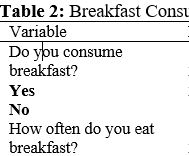
Results: The study involved 285 secondary school students with a mean age of 14.59 ± 1.68 years. The majority were female (64.3%), while males constituted 34.7% of the respondents. The majority of the students (92.4%) reported consuming breakfast, while only 7.3% did not. Among those who consumed breakfast, 79.9% did so daily, and 19.1% rarely ate breakfast. . Among those who skipped breakfast, the most cited reason was lack of time (50.7%), followed by lack of appetite (25.0%) and food constraints (20.8%). Only 1.0% said they did not skip breakfast at all. Most respondents (88.5%) believed that breakfast consumption positively impacted their energy levels or focus in school.
Conclusion: A high prevalence breakfast consumption was observed with most students eating daily and preferring home-made meals.
Downloads
Published
Issue
Section
License
Copyright (c) 2025 Oluwadamilola Bukola Adekolujo, Esther Oluwatomiwa Neyin

This work is licensed under a Creative Commons Attribution 4.0 International License.