Sensory Properties, Proximate, Vitamin and Anti-Nutrient Composition of Awara-Based Kilishi Analogue with Suya Spice
DOI:
https://doi.org/10.54117/ccv6q948Keywords:
Plant-meat, sustainable protein, soybean, high-qualityAbstract
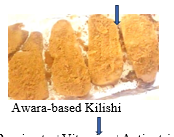
Awara-based kilishi analogue with suya spice was produced and subjected to sensory, proximate, vitamin and antinutrient analysis using standard methods. The awara-based kilishi formulated with awara:suya spice ratio of 83.33:16.67, 79.85:20.15 and 75.62:24.38 showed percentage acceptability index of 82.78, 85.56 and 80.0%, respectively, which means high consumers acceptance and was further analyzed. The awara-based kilishi with suya spice with ratio 83.33:16.67 had the highest protein [35.04%], fiber (0.63%) and fat [22.92%] level while 75.62:24.38 ratio had the highest ash [3.99%] and carbohydrate [38.88%] with least moisture of 5.08%. Sample ratio 75.62:24.38 contained the highest level of vitamin B12 [230 µg/100], B6 [1020µg/100], B1 [420µg/100] and C [35.40mg 100g-1]. Stachyose, trypsin, lectin, phytate, glycine and raffinose content of the awara-based kilishi analogue samples ranged from 0.54 to 0.83, 1.15 to 1.19, 0.14 to 0.19, 2.19 to 2.25, 0.22 to 0.73 and 0.24 to 0.27mg 100g-1 and were all within acceptable limits. The addition of the suya spice notably enhanced the ash and crude fiber content of the awara-based kilishi compared to the control [100% awara-based kilishi without suya spice] sample. Findings showed the product to be a viable alternative to traditional animal-based kilishi when considering health and environmental effect.
Downloads
Published
Issue
Section
License
Copyright (c) 2026 Eunice Ngozi Odoh, Chisom Chimdi Ojiabo, Clement Chinedum Ezegbe, Cynthia Kenechukwu Onyenwenwa, Jennifer Oluebube Orji, Ernest Chukwusoro Igwe

This work is licensed under a Creative Commons Attribution 4.0 International License.