
Improving the Chemical Composition and Functionality of Cowpea (Vigna unguiculata) Seeds via Lactic Acid Fermentation
DOI:
10.54117/ijamb.v4i2.61Published:
2025-06-20Issue:
Vol. 4 No. 2 (2025): Jul-AugKeywords:
cowpea seeds, lactic acid fermentation, chemical composition, functional propertiesArticles
Downloads
How to Cite
Downloads
Abstract
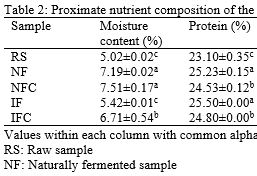
Legumes, particularly cowpea (Vigna unguiculata), are an important source of nutrients, especially in developing countries. Despite being part of the staple diets of these populations, the consumption of cowpea is limited by the flatulence they produce. Natural lactic acid fermentation has proven to be an effective method to decrease flatulence-producing compounds. However, in order to use this method as a process on a large scale, it is fundamental to identify the microbial flora involved. When fermented seeds of Vigna unguiculata (Cowpea) were analyzed microbiologically, it was found that the micro-organisms present were Lactobacillus fermentum, Lactobacillus cellobiosus and Lactobacillus plantarum. On performing back-slopping or induced fermentation, there was a significant (p≤0.05) increase in the protein from 23.1% in raw sample to 25.5% in the fermented product; and a 57.3%, 53.3% and 38.9% respective decreases in oxalate, phytate and tannin contents, when compared to the raw sample. When cooking of the spontaneous and induced fermented samples was done there was a reduction in the anti-nutritional components and thus increase in potassium and phosphorus contents of the samples from 385.67±0.56 mg/100g and 459.33±0.56 mg/100g in the raw sample to 417.00±0.00 mg/100g and 435.33±0.56 mg/100g in the product, for the spontaneous and induced fermented samples, respectively. There was also a significant (p≤0.05) reduction in the bulk density from 0.76 ±0.03 g/cm3 in raw samples to 0.65± 0.01 g/cm3 and 0.60± 0.01 g/cm3 in spontaneous and induced fermented cowpea seeds, underscoring the usefulness of the fermented product in weaning diets formulation, with increases in the water absorption, oil absorption and emulsifying capacities. All these results demonstrate that the lactic acid bacteria used for the induced fermentation (or back-slopping) can lead to a functional food with improved nutritional quality.
Author Biographies
Taiwo O. Olukunle, Department of Food Science and Technology, Federal University of Technology, Akure, Nigeria.
Oluwayemisi M. Oni, Department of Food Science and Technology, Federal University of Technology, Akure, Nigeria.
Catherine O. Babatuyi, Department of Nutrition and Dietetics, Federal University of Technology, Akure, Nigeria.
Mercy A. Okeji, Department of Food Science and Technology, Federal University, Oye-Ekiti, Nigeria.
Victor N. Enujiugha, Department of Food Science and Technology, Federal University of Technology, Akure, Nigeria.
License
Copyright (c) 2025 Taiwo O. Olukunle, Oluwayemisi M. Oni, Catherine O. Babatuyi, Mercy A. Okeji, Victor N. Enujiugha

This work is licensed under a Creative Commons Attribution 4.0 International License.
CC BY 4.0