
Multiple Antibiotic Resistance Bacterial Strains in Frozen Meat Sold at Abagana, Anambra State: A Public Health Concern
DOI:
10.54117/ijamb.v4i3.75Published:
2025-08-17Issue:
Vol. 4 No. 3 (2025): Aug-SeptKeywords:
Microbiological, Susceptibility, Isolates, Frozen Meat, Antibiotic ResistanceArticles
Downloads
How to Cite
Downloads
Abstract
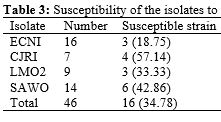
This study investigates the molecular analysis of bacterial isolates from frozen chicken and determines their antibiotic resistance profiles. A total of 50 frozen chicken samples were collected and analyzed using standard microbiological techniques. The results revealed the presence of four bacterial species: Escherichia coli O157:H7 strain NE 1127, Campylobacter jejuni strain RM 1221, Listeria monocytogenes serotype 4b strain 02-6680, and Staphylococcus aureus starin WHC09. The antibiotic susceptibility testing showed that 57.14% of the isolates were resistant to conventional antibiotics, while 42.86% were susceptible. Notably, 20.00% of the resistant strains exhibited single antibiotic resistance, and 80.00% displayed multiple antibiotic resistance (MAR). Statistical analysis using the student "t" test, correlation coefficient and one-way analysis of variance (ANOVA) confirmed the significance (p ≤ 0.05) of these findings. The study's results highlight the risk of food-borne disease outbreaks associated with the consumption of frozen chicken contaminated with antibiotic-resistant bacteria. The high prevalence of MAR among the bacterial isolates underscores the need for improved sanitation practices, regular water quality monitoring, and public awareness campaigns to mitigate the spread of antibiotic-resistant bacteria.. The study's results are crucial for informing policy decisions and guiding future research on antibiotic resistance in the food industry
Author Biographies
C. N. Dim, Department of Physiology, Chukwuemeka Odumegwu Ojukwu University, Anambra State.
I. H. Iheukwumere, Department of Microbiology, Faculty of Natural Sciences, Chukwuemeka Odumegwu Ojukwu University, Anambra State, Nigeria.
C. M. Iheukwumere, Department of Applied Microbiology & Brewing, Faculty of Biosciences, Nnamdi Azikiwe University Awka, Nigeria.
C. H. Ugwu, Department of Applied Microbiology & Brewing, Faculty of Biosciences, Nnamdi Azikiwe University Awka, Nigeria.
V. E. Ike, Department of Microbiology, University of Agriculture and Environmental Sciences, Umuagwo, Imo State Nigeria.
J. N. Ezendianefo, Department of Microbiology, Tansian University, Umunya, Anambra State.
P. A. Egbe, Department of Microbiology, Faculty of Natural Sciences, Chukwuemeka Odumegwu Ojukwu University, Anambra State, Nigeria.
I. P. Oragwu, Department of Industrial Chemistry, Faculty of Natural Sciences, Chukwuemeka Odumegwu Ojukwu University, Anambra State.
C. C. Orji, Department of Applied Microbiology & Brewing, Faculty of Biosciences, Nnamdi Azikiwe University Awka, Nigeria.
O. C. Ogbonnaya, Department Science Laboratory Technology, Oko Polytechnic, Anambra State.
U. F. Onwuasoanya, Department of Medical Microbiology and Public Health, Faculty of Medical Laboratory Science, Nnamdi Azikiwe University.
F. O. Okereke, Department of Microbiology, Spiritan University, Umunze, Abia State.
P. M. Oduenyi, Registry Department, Chukwuemeka Odumegwu Ojukwu University, Anambra State.
S. C. Ochibulu, Department of Microbiology, Faculty of Natural Sciences, Chukwuemeka Odumegwu Ojukwu University, Anambra State, Nigeria.
License
Copyright (c) 2025 C. N. Dim, I. H. Iheukwumere, C. M. Iheukwumere, C. H. Ugwu, V. E. Ike, J. N. Ezendianefo, P. A. Egbe, I. P. Oragwu, C. C. Orji, O. C. Ogbonnaya, U. F. Onwuasoanya, F. O. Okereke, P. M. Oduenyi, S. C. Ochibulu

This work is licensed under a Creative Commons Attribution 4.0 International License.
CC BY 4.0